
Do You Really Need 35-Pass Erasure?
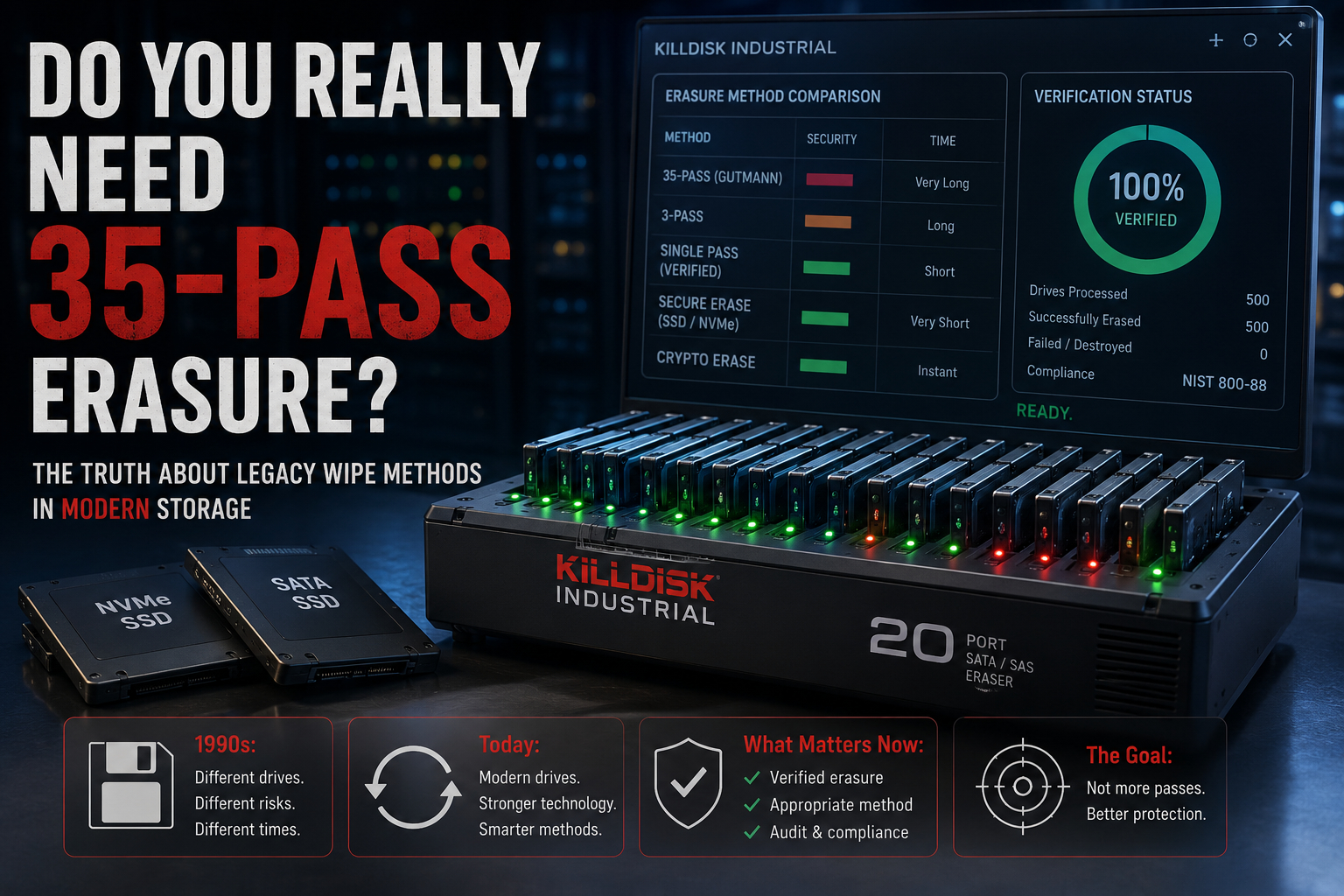
For decades, the phrase “35-pass wipe” sounded like the gold standard of secure data destruction.
The logic seemed obvious:
If overwriting a drive once is good, then overwriting it 35 times must be even better.
Entire industries adopted multi-pass erasure policies. IT departments scheduled overnight wipe jobs. Security-conscious users waited days for disk sanitization to complete — convinced that anything less would leave recoverable traces behind.
But modern storage technology has changed dramatically.
And today, one uncomfortable question keeps resurfacing:
Do you actually need 35-pass erasure anymore?
Where the 35-Pass Idea Came From
The famous 35-pass method originated from research by computer scientist Peter Gutmann in the 1990s.
At the time, hard drives used a wide variety of magnetic encoding technologies. Gutmann designed overwrite patterns intended to target different recording methods that existed across older disk architectures.
The theory was that sophisticated forensic laboratories might recover faint residual magnetic traces from previously written data.
So the Gutmann method attempted to eliminate every possible remnant through dozens of carefully designed overwrite sequences.
Back then, this concern was more reasonable than it sounds today.
Hard drives had:
- lower recording density,
- less sophisticated firmware,
- and fundamentally different magnetic behavior.
But technology moved on.
Fast.
Modern Drives Are Not 1990s Hard Drives
Today’s storage devices bear little resemblance to the disks that inspired the original Gutmann paper.
Modern HDDs use:
- extremely high recording densities,
- advanced error correction,
- firmware-level remapping,
- and sophisticated magnetic encoding systems.
Meanwhile SSDs introduced an entirely different architecture based on flash memory, wear leveling, and controller-managed storage allocation.
As a result, many assumptions behind legacy multi-pass wiping no longer apply.
A modern overwrite pass already destroys data with a level of precision unimaginable in the 1990s.
And SSDs don’t even guarantee that repeated overwrites touch the same physical cells.
The Myth of Infinite Recoverability
One reason 35-pass wiping survived for so long is simple:
People imagine data recovery labs as magical places capable of resurrecting anything.
Movies helped reinforce the myth:
- “enhancing” blurry images,
- recovering deleted files instantly,
- rebuilding destroyed drives from fragments.
In reality, recovering overwritten modern data is extraordinarily difficult.
For contemporary hard drives, a single verified overwrite pass is generally considered sufficient against practical recovery attempts.
And for SSDs, repeated overwrites may actually be less reliable than firmware-based sanitize commands.
What Modern Standards Actually Recommend
Perhaps the biggest surprise is this:
Most modern cybersecurity standards do not require 35-pass wiping.
Current guidance from standards like NIST 800-88 focuses on:
- verification,
- sanitization method suitability,
- cryptographic erase,
- firmware secure erase,
- and operational validation.
The emphasis shifted away from “how many passes” toward:
- whether the process is appropriate for the media,
- whether it completed correctly,
- and whether the result can be verified.
In many enterprise environments:
- a single-pass overwrite,
- secure erase command,
- or cryptographic key destruction is entirely acceptable when properly implemented.
Why 35 Passes Can Be Counterproductive
Ironically, excessive overwrite passes can create new problems.
Time Explosion
A 35-pass wipe can take:
- many hours,
- or even multiple days on large storage arrays.
At enterprise scale, that becomes operationally impractical.
Imagine processing:
- 500 SSDs,
- 2 PB of storage,
- or an entire data center migration with 35-pass policies.
The delays become enormous.
SSD Wear
For SSDs, repeated overwrites also contribute unnecessary write wear.
Flash memory has finite program/erase cycles.
Excessive overwriting:
- increases wear,
- generates heat,
- and may still fail to sanitize hidden remapped blocks.
That’s why modern SSD workflows rely more heavily on:
- NVMe sanitize,
- firmware secure erase,
- PSID revert,
- and cryptographic erase.
So Why Do Some Organizations Still Use It?
Partly because of institutional inertia.
Security policies often outlive the technologies they were written for.
Some organizations still reference:
- legacy DoD standards,
- outdated procurement requirements,
- or inherited compliance language.
And psychologically, more passes simply feel safer.
“35 passes” sounds stronger than “1 verified overwrite.”
Even if the actual security difference is negligible on modern hardware.
What Matters More Than Pass Count
Today, effective data sanitization depends far more on:
Verification
Did the erase actually complete successfully?
Media Awareness
Is the method appropriate for:
- HDD,
- SSD,
- NVMe,
- RAID,
- or self-encrypting drives?
Auditability
Can you prove:
- who performed the erase,
- when it occurred,
- and whether validation succeeded?
Failure Handling
What happens if:
- firmware freezes,
- sectors become unreadable,
- or sanitize commands fail?
In mature workflows, failed drives are often physically destroyed instead of endlessly overwritten.
The Modern Reality
The cybersecurity world has quietly shifted away from obsession with overwrite counts.
Today’s best practices prioritize:
- verified sanitization,
- automation,
- cryptographic approaches,
- and media-specific workflows.
The famous 35-pass wipe remains historically important.
But for most modern storage devices, it is no longer technically necessary.
In many cases, it simply wastes time while offering little additional protection.
The real challenge in modern data destruction is no longer writing over data repeatedly.
It’s proving the sanitization process was performed correctly in the first place.