
DoD 5220.22-M Is Obsolete — Here’s Why
Introduction
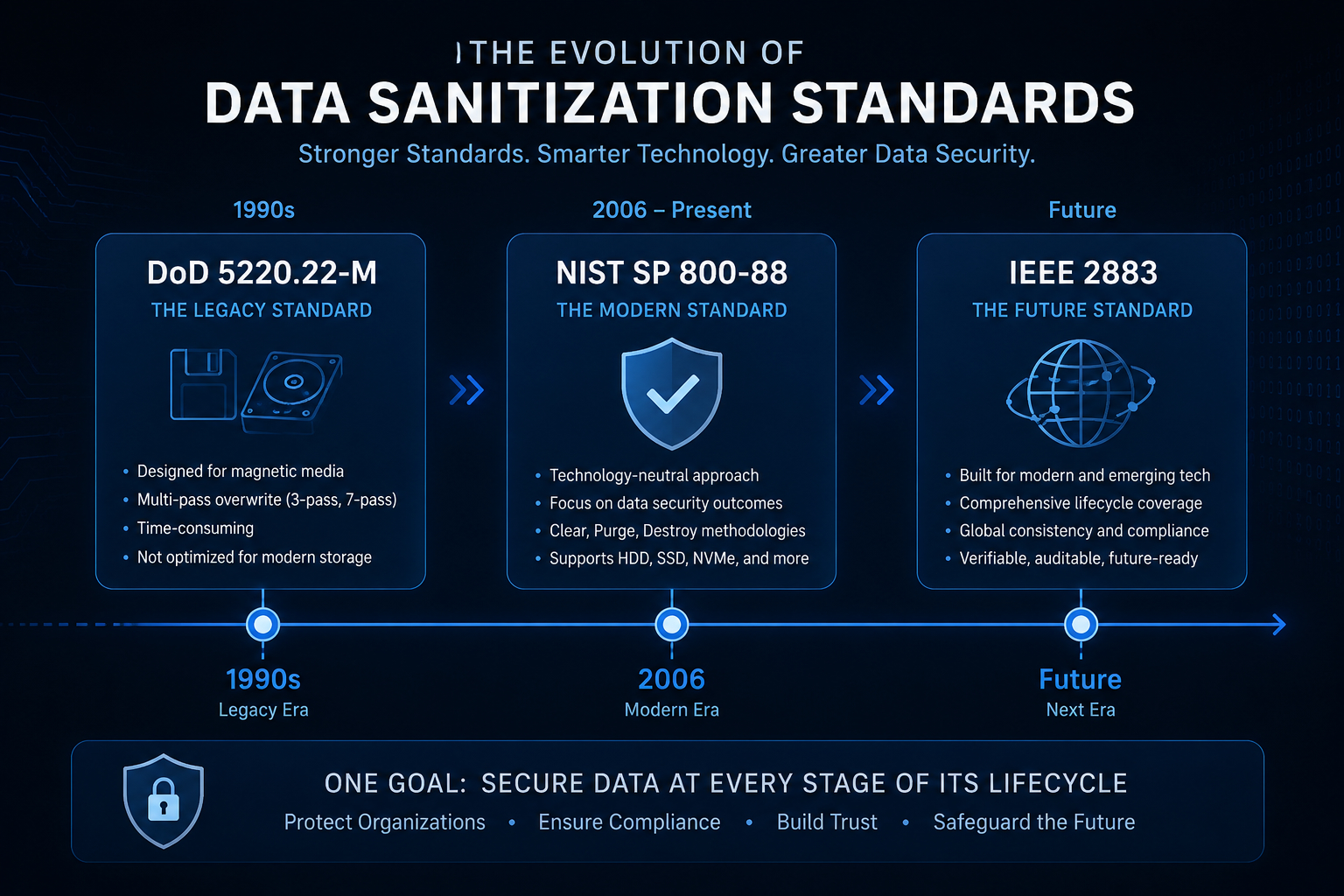
For years, “DoD wipe” became synonymous with secure data erasure.
Many IT professionals still ask:
- “Does your software support DoD 5220.22-M?”
- “Should I use a 3-pass or 7-pass wipe?”
- “Is DoD still the gold standard?”
The short answer: No.
The DoD 5220.22-M standard is outdated, misunderstood, and no longer recommended for modern storage technologies.
Yet despite this, it continues to appear in software menus, procurement checklists, and IT policies around the world.
So what happened?
And what should organizations use instead?
What Is DoD 5220.22-M?
DoD 5220.22-M originated from the U.S. Department of Defense National Industrial Security Program Operating Manual (NISPOM).
Over time, it became associated with a software overwrite method designed to sanitize magnetic hard drives by writing patterns of data across the disk multiple times.
The most commonly referenced variations included:
- 3-pass overwrite
- 7-pass overwrite
- verification pass
For many years, the logic seemed simple:
More overwrite passes = more security.
But storage technology changed dramatically.
The standard did not.
The Biggest Myth: “More Passes Are Safer”
This idea largely comes from the 1990s — an era of older magnetic drives with lower recording density.
Back then, there were theoretical concerns that advanced laboratory techniques might recover residual magnetic traces after overwriting.
Today, those concerns are largely irrelevant for modern drives.
Modern HDDs use:
- extremely high areal density,
- advanced signal processing,
- sophisticated firmware-level management.
As a result, a single properly executed overwrite pass is generally considered sufficient for magnetic drives.
In fact, modern guidance from organizations like NIST no longer recommends excessive multi-pass overwriting for routine sanitization.
Multiple overwrite passes mostly increase:
- processing time,
- energy consumption,
- operational bottlenecks.
Not security.
SSDs Changed Everything
The real reason DoD 5220.22-M became obsolete is simple:
It was never designed for SSDs.
Traditional overwrite methods assume direct physical access to storage sectors.
SSDs do not work that way.
Modern solid-state drives use:
- wear leveling,
- overprovisioning,
- remapped blocks,
- TRIM operations,
- internal firmware management.
This means software overwriting cannot reliably guarantee that every physical NAND cell was overwritten.
An overwrite command may target logical sectors while the SSD silently redirects writes elsewhere internally.
As a result:
- some blocks may remain untouched,
- hidden areas may persist,
- traditional multi-pass logic breaks down entirely.
This is why modern SSD sanitization relies on different approaches:
- ATA Secure Erase,
- NVMe Sanitize,
- cryptographic erase,
- firmware-based sanitization.
DoD overwrite patterns simply do not address modern SSD architecture.
NIST Replaced the Old Thinking
Today, the most widely referenced guidance comes from NIST SP 800-88 Revision 1.
Instead of focusing on “how many overwrite passes,” NIST focuses on:
- storage type,
- sanitization method,
- verification,
- risk level,
- intended reuse or destruction.
This is a major shift.
Modern sanitization is no longer about blindly repeating overwrite patterns.
It is about choosing the correct sanitization method for the specific media type.
For example:
- HDDs may use overwrite or firmware erase,
- SSDs often require cryptographic erase or sanitize commands,
- failed drives may require destruction,
- enterprise workflows require auditability and verification.
This approach is far more practical for real-world IT environments.
Why Do Companies Still Use “DoD Wipe”?
Mostly because the term became part of IT culture.
People recognize it. Procurement departments ask for it. Legacy policies still reference it.
In many cases, organizations continue using “DoD wipe” simply because:
- policies were never updated,
- compliance documents were copied forward for years,
- vendors continued marketing the term.
Ironically, many organizations using “DoD wipe” today are applying an outdated HDD-era concept to modern NVMe SSD infrastructure.
The Real Problem with Legacy Erasure Thinking
The issue is not merely technical.
It is operational.
Modern enterprise environments process:
- thousands of SSDs,
- high-density NVMe arrays,
- virtualized infrastructure,
- large-scale decommissioning workflows.
In these environments, outdated multi-pass erasure creates serious inefficiencies:
- unnecessary processing time,
- lower throughput,
- higher power consumption,
- workflow delays,
- reduced scalability.
A 7-pass overwrite across hundreds of modern drives may consume hours with little or no meaningful security benefit.
At scale, obsolete sanitization practices become expensive.
What Modern Data Sanitization Looks Like
Modern erasure workflows focus on:
- media-aware sanitization,
- automation,
- verification,
- audit logging,
- scalability,
- standards compliance.
Instead of blindly applying one overwrite pattern everywhere, organizations now use:
- firmware-based erase commands,
- cryptographic sanitization,
- automated verification,
- centralized reporting,
- parallel drive processing.
The goal is no longer “more overwrite passes.”
The goal is: secure, verifiable, scalable sanitization.
So Is DoD 5220.22-M Completely Useless?
Not exactly.
Overwrite-based erasure can still be effective for certain magnetic drives.
But the idea that DoD 5220.22-M represents the ultimate or universal standard for modern data sanitization is outdated.
Today’s storage ecosystem requires more intelligent approaches.
The industry moved beyond:
- floppy-disk-era assumptions,
- HDD-only workflows,
- multi-pass mythology.
The future of sanitization is media-specific, automated, and verification-driven.
And that future is already here.
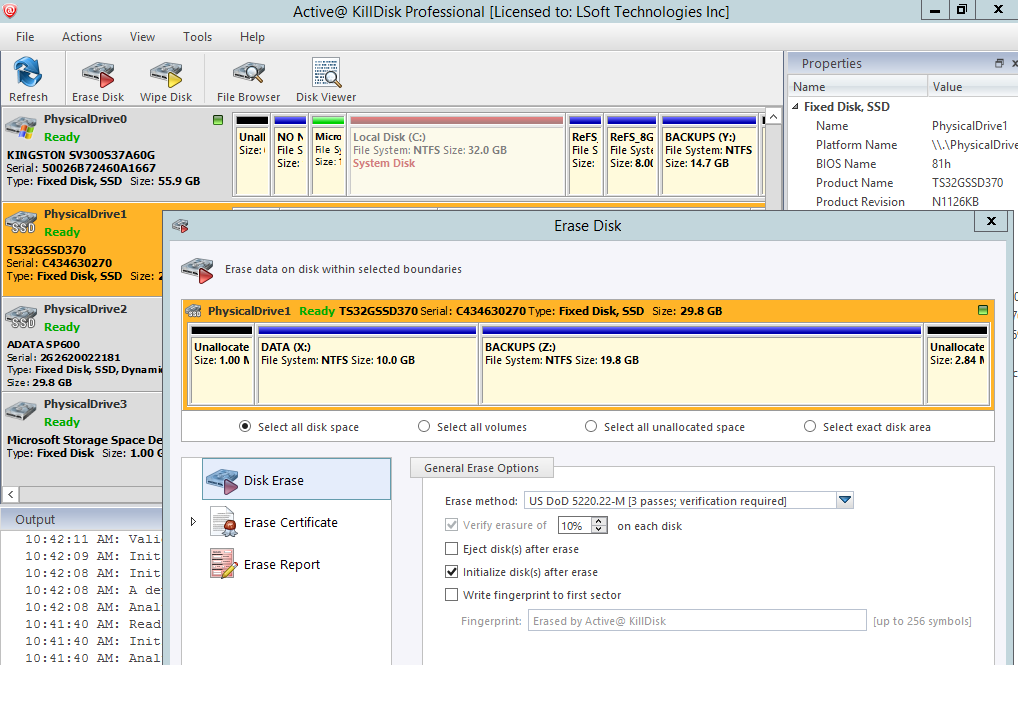
Final Thoughts
DoD 5220.22-M played an important historical role in data sanitization.
But modern storage technologies evolved faster than the standard itself.
Today, secure erasure is no longer about repeating overwrite passes as many times as possible.
It is about understanding the storage media, using the right sanitization method, and verifying the result.
That is what modern data security requires.