
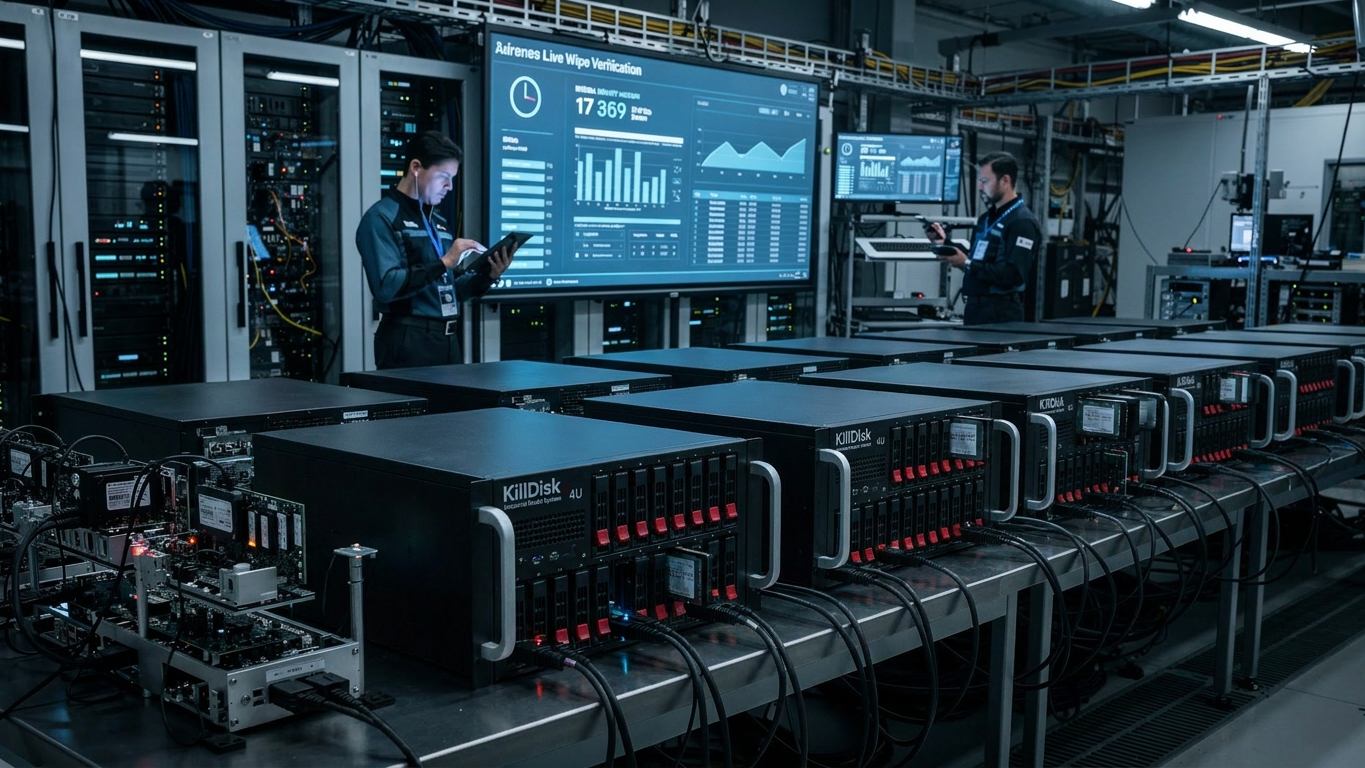
A Day Processing 500 SSDs
Inside a High-Volume Data Sanitization Workflow
At 7:30 AM, the first pallets arrive.
Cardboard boxes filled with retired laptops, servers, workstation drives, and loose SSDs begin stacking near the intake station. Some come from hospitals. Others from financial institutions, universities, law firms, and government contractors. Every drive contains something invisible but valuable: data.
Today’s target is ambitious even by industrial standards — 500 SSDs in a single shift.
And unlike traditional hard drives, SSDs introduce a completely different level of complexity.
Why SSDs Changed Everything
For years, data destruction was straightforward.
Overwrite the drive multiple times. Verify the result. Archive the report.
But SSDs do not behave like magnetic disks.
Because of wear leveling, hidden reserve blocks, TRIM behavior, and controller-level remapping, simply writing zeros across visible sectors does not always guarantee complete sanitization.
That reality transformed SSD erasure from a simple overwrite operation into a verification-driven engineering process.
Modern workflows now rely on:
- NIST 800-88 guidelines
- NVMe Secure Erase commands
- Firmware-level sanitize operations
- Hardware verification
- Automated logging and chain-of-custody tracking
Processing 500 SSDs in a day is no longer just about speed.
It’s about precision at scale.
08:00 — Intake and Identification
Every SSD entering the facility receives:
- Asset ID
- Barcode
- Chain-of-custody registration
- Device classification
- Capacity and interface detection
Technicians separate drives into categories:
- SATA SSDs
- NVMe drives
- M.2 modules
- Enterprise U.2/U.3 devices
- Failed or damaged drives
This matters because each interface may require different erase methods and hardware adapters.
At industrial volume, workflow organization becomes as important as the erase itself.
A mislabeled drive can break compliance reporting.
09:15 — The Erasure Queue Begins
Rows of erase stations come online simultaneously.
Industrial sanitization systems process dozens of drives in parallel while software automatically selects the appropriate method:
Typical Decision Tree
| Drive Condition | Recommended Action |
|---|---|
| Healthy SSD | Firmware Secure Erase |
| NVMe Enterprise Drive | NVMe Sanitize |
| Locked SSD | PSID Revert |
| Failing Drive | Partial sanitize + physical destruction |
| Unresponsive Device | Destruction workflow |
The goal is not merely “deleting files.”
The goal is generating a defensible proof that the information cannot be reconstructed.
SSDs That Refuse to Cooperate
Around midday, the first problematic devices appear.
Some SSDs:
- freeze during sanitize commands,
- disappear from the bus,
- report false completion,
- or throttle under thermal load.
Consumer SSD firmware can be unpredictable under continuous industrial workloads.
One failed erase on a personal laptop is annoying.
One failed erase in a healthcare disposal batch can become a compliance incident.
Technicians constantly monitor:
- SMART health indicators,
- erase completion status,
- firmware responses,
- bad block growth,
- and verification mismatches.
Industrial data sanitization often looks less like IT support and more like forensic engineering.
Verification Is Everything
By 2 PM, most drives have technically completed erasure.
But completion alone means nothing without validation.
Modern workflows include:
- sector verification,
- random sampling,
- hash validation,
- firmware response analysis,
- and reporting integrity checks.
Some organizations require full audit trails for every single device processed.
That means every SSD generates:
- serial number logs,
- timestamps,
- erase method records,
- operator information,
- verification status,
- and final certification.
When processing 500 drives, reporting automation becomes critical.
Without it, documentation would consume more time than sanitization itself.
The Human Side of the Process
Large-scale erasure operations are surprisingly physical.
Technicians spend hours:
- swapping adapters,
- scanning barcodes,
- moving batches,
- troubleshooting failed devices,
- and managing heat buildup.
Hundreds of SSDs running simultaneously generate substantial thermal load.
Fans roar continuously.
Status LEDs flash across entire racks.
Large monitors display live progress dashboards showing:
- active jobs,
- failed drives,
- throughput rates,
- and verification percentages.
At scale, data destruction resembles a manufacturing line more than a traditional IT environment.
17:40 — Final Numbers
At the end of the shift:
- 500 SSDs processed
- 472 successfully sanitized
- 28 physically destroyed after failure or instability
- Thousands of gigabytes permanently removed
- Full compliance reports exported
Tomorrow, another shipment arrives.
Different drives. Different firmware. Different surprises.
But the mission stays the same:
Ensure that retired hardware never becomes a future data breach.
The Future of SSD Sanitization
As storage technology evolves, sanitization becomes more challenging.
Emerging trends include:
- self-encrypting drives (SEDs),
- PCIe Gen5 NVMe devices,
- enterprise hyperscale storage,
- and increasingly opaque controller architectures.
Future workflows will likely rely more heavily on:
- hardware-assisted cryptographic erase,
- AI-assisted failure detection,
- predictive firmware analytics,
- and automated compliance auditing.
Because in modern cybersecurity, deleting data is no longer enough.
You must be able to prove it was truly gone.